

The Language House: why reading starts long before Prep
I am visiting a lot of schools at the moment, talking to parents about their children starting Prep next year. During my talk I love to share the concept of Pam Snow’s Language House. With this reflection I decided to put it down in words.
Two children start Prep on the same morning. Both are five. Both are excited.
One has been read to most nights since she was a baby. She asks endless questions and can retell her weekend with a beginning, a middle and an end. The other is just as loved and just as capable. His first five years simply held fewer books, fewer long conversations and fewer unfamiliar words.
Both children will be taught to read in the same room, by the same teacher, with the same program. Whether that program closes the gap or widens it depends on what the school does next.
Why language matters for reading
Reading is not one skill. Scarborough’s Reading Rope shows it as two strands twisted together. One strand is word recognition: hearing sounds in words, decoding print and recognising words automatically. The other is language comprehension: vocabulary, sentence structure, background knowledge, verbal reasoning and knowledge of how texts work.
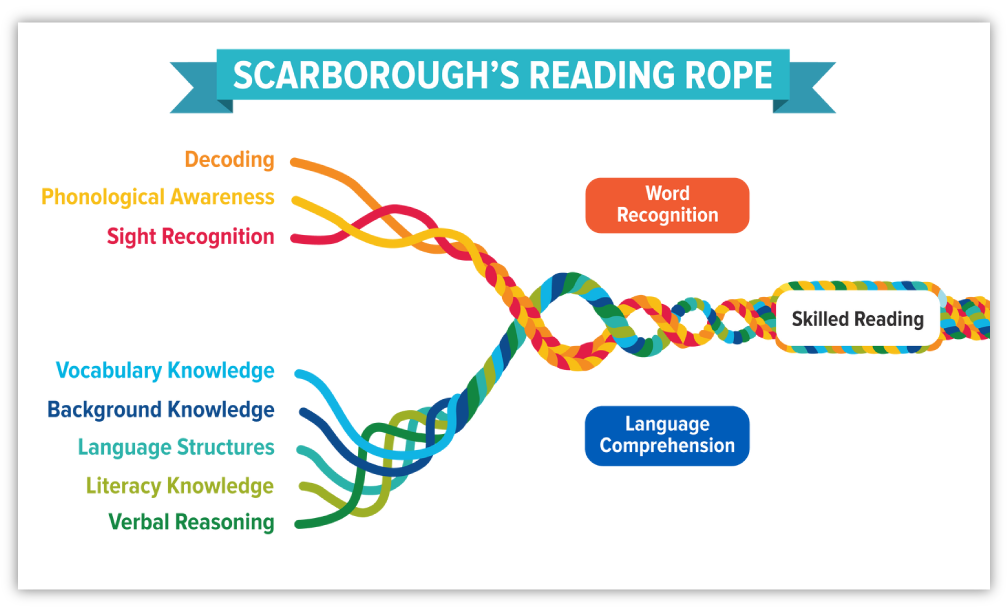
The Simple View of Reading says the same thing in fewer words. Reading comprehension needs both decoding and language comprehension. If either is weak, comprehension suffers.
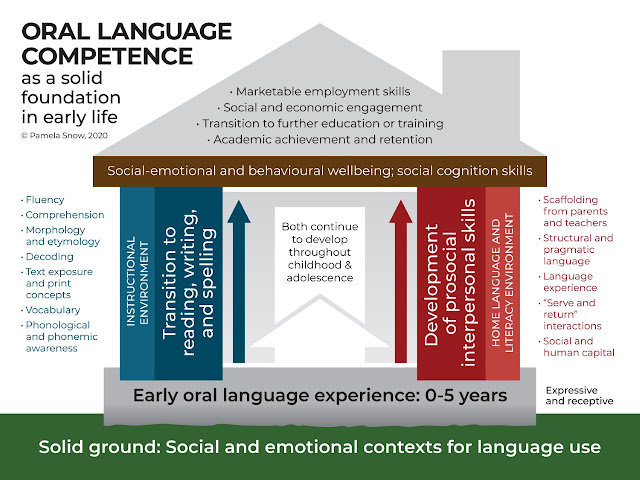
So where does language comprehension come from? Professor Pamela Snow of La Trobe University offers a useful picture. She calls it the Language House.
Building the house
Snow is clear that this is a conceptual model. It does not cover everything. It helps us think about how a number of developmental processes need to come together, from infancy through to adolescence.
The ground. Before foundations, you need something solid to build on. In this model, that is supportive, responsive adults. A baby babbles, an adult answers. A toddler points, an adult names. These “serve and return” exchanges support attachment, emotional regulation and language at the same time. Children who can name their feelings find them easier to manage. The ground is all about safe and supportive environments where children feel safe and connected.
The foundations. These are the first five years of language exposure. Vocabulary is the cornerstone. But so are conversation and storytelling, sentence structure, speech sounds and word parts. Children do not arrive at school with the same amount of exposure. Some houses are full of language and others are not. It is not a statement about how much families care.
The walls. There are two. One is the social skills that let children use language to make friends and work things out. The other is literacy. They hold each other up. Language supports reading. Then reading gives children richer vocabulary and more complex sentences than everyday talk ever does.
Children who become confident readers earlier are typically exposed to more vocabulary, knowledge and complex language through reading. Children who experience ongoing reading difficulties may have fewer opportunities for this exposure unless additional supports are provided.
This is often called the Matthew effect. The Matthew effect in reading is the pattern where strong readers get progressively better over time while struggling readers fall further behind. (The next post looks at what the research says about it – check it out here.)
The roof. Social understanding and wellbeing sit as a rafter. The roof itself is access to further study and work, academic success. Low language and literacy skills are associated with increased risk of poorer educational, employment and social outcomes across the lifespan.
What schools can and cannot change
We cannot change the ground or the foundations a child brings through the gate. We can change the instruction they receive from the first day.
Foundations are critical, but they are not enough. Being read to builds vocabulary, language and knowledge. However, most children also require explicit instruction in how print represents spoken language to become skilled readers.
(Check out post three in our series for more about this – here)
Three things to take back to your school
- Close the gap, don’t explain it. Know what children bring, then teach to build it.
- Keep teaching language past Year 2. Snow notes that language stays important across the school years, and needs background knowledge alongside it for students to make meaning from texts. WE are always learning new words and ways to express ourselves. I still learn new words at 53years!
- Treat wellbeing and literacy as connected. Reading difficulties are over-represented in children who had language difficulties in the early years, and literacy and social-emotional difficulties often occur together.
Sources
- Snow, P. (2020). Updating the Language (and Literacy) House. The Snow Report. pamelasnow.blogspot.com
- Snow, P. (2020). The Science of Language and Reading. Child Language Teaching and Therapy.
- Snow, P. (2016). Language is literacy is language. International Journal of Speech-Language Pathology.
- Scarborough, H. (2001). Connecting early language and literacy to later reading (dis)abilities. In Neuman and Dickinson (Eds.), Handbook of Early Literacy Research.
- Gough, P. and Tunmer, W. (1986). Decoding, reading, and reading disability. Remedial and Special Education.
Head to our second Blog in this series – here
Check out our series
The Language House: Why Reading Starts Long Before Prep
The Matthew Effect in Reading: Why Early Reading Matters So Much
What to Teach in Literacy: The Key Elements and How to Teach Them
What is your school already doing well? A literacy audit
Multi-tiered Support: Keeping Literacy Support Targeted
Implementing literacy change in schools: deciding what is in and what is out