
The Matthew effect: why early reading matters so much
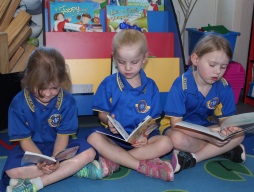
Picture a Year 1 reading table in Term 1. Four children, the same book, the same teacher. By the end of Year 3, some of those children are reading for pleasure and picking up new words from every page. One or two are still working to get through a page at all.
Nobody did anything wrong. The gap simply grew.
Researchers have a name for this pattern. They call it the Matthew effect.
Where the term comes from
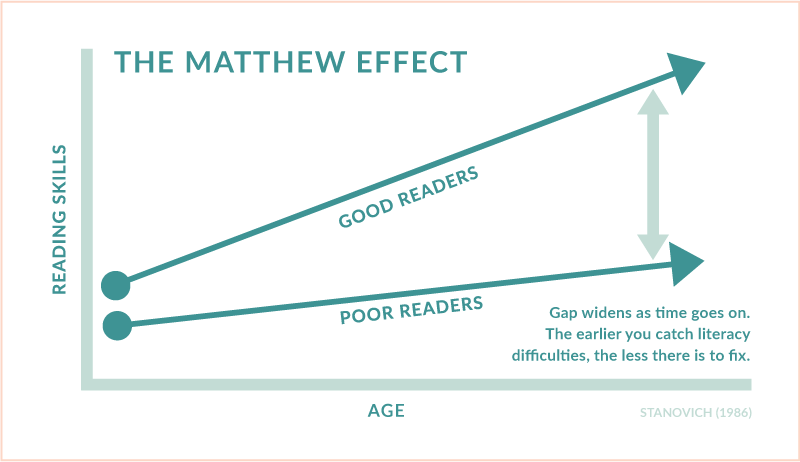
The name comes from a verse in the Gospel of Matthew: those who have are given more, and those who have little lose even that. Keith Stanovich brought the idea into reading research in 1986. His point was that advantage compounds. In reading, he wrote, the rich get richer and the poor get poorer. He described reading and the skills around it as bootstrapping each other: better reading builds the very skills that make the next reading easier.
How the loop is thought to work
The usual explanation is a loop.
- A child who reads well, reads more, and meets more words and ideas.
- More words and ideas build vocabulary and knowledge.
- Vocabulary and knowledge make the next text easier to understand.
- Success builds confidence, and reading becomes something the child chooses to do.
For a child who finds reading hard, the loop runs the other way. Reading is slow and tiring. Texts are harder to follow. Reading gets avoided. The child meets fewer new words.
This is the same pattern as the walls of the Language House in Blog one (check it out here). Language helps reading, and reading feeds language.
Not every link in the loop has been tested equally well. So here is what the studies show.
The invisible school bag
Children arrive at school carrying something we cannot see. It is not in their bags. It is the words they know, the ideas they have met and the ways they have heard language used.
A few years ago I read an article that called this the invisible school bag. The idea has stayed with me. It is also backed by research.
The original work is from Hart and Risley (1995) but has been replicated more recently with newer studies.
On average, socioeconomic disadvantage is associated with increased risk of lower vocabulary scores at school entry, although there is substantial variation within all socioeconomic groups.
It shows up in Australia. Taylor and colleagues (2013) used data from 4,332 children in the Longitudinal Study of Australian Children. At age 4, low family income, low maternal education and not being read to at home were among the risk factors for lower vocabulary. Between ages 4 and 8, the only factor linked to slower vocabulary growth was living in a socio-economically disadvantaged area. By age 8, those children were about eight months behind in vocabulary development. The authors note that this fits other research showing that social gaps in child development tend to widen over time.
Two things matter when we read this.
- These are averages, not individual children. Dr Pam Snow points out that income correlates with the language children hear. It does not determine it. Some families facing hardship provide rich language, and some well-off families do not. This isn’t about blaming parents. It is about taking what we know about the children we work with and build on it.
We cannot change the bag a child arrives with. We can change what happens once they walk through the door. Read more here
What schools can do
- Look at language as well as word reading. Children with lower comprehension grew vocabulary more slowly, and early vocabulary predicted later reading. A screen that checks only decoding will miss these children.
- Teach word reading explicitly from the start. Children who can read independently will be presented with more words and will use these words to support comprehension. (check out post three in our series).
- Build vocabulary and knowledge through teaching, not only through reading. Dr Pam Snow notes that children need richer vocabulary and more complex sentences than everyday conversation provides. Reading aloud books above what children can read for themselves is one way to give them that while their decoding develops.
- Give struggling readers plenty of successful reading practice. The research links reading experience to vocabulary, and a child who is always reading texts that are too hard gets little of either.
- Do not wait. Check progress regularly and respond early. That is what tiers are for. Check out our 5th post in our series.
The point of the Matthew effect
It is not a verdict on any child. It is a reminder that time matters and that what we do early counts.
Next time: what to teach, and how.
Sources
- Stanovich, K. E. (1986). Matthew effects in reading: Some consequences of individual differences in the acquisition of literacy. Reading Research Quarterly, 22, 360-407.
- Cain, K. and Oakhill, J. (2011). Matthew effects in young readers: Reading comprehension and reading experience aid vocabulary development. Journal of Learning Disabilities, 44(5), 431-443.
- Duff, D., Tomblin, J. B. and Catts, H. (2015). The influence of reading on vocabulary growth: A case for a Matthew effect. Journal of Speech, Language, and Hearing Research, 58(3), 853-864.
- Bleses, D., Makransky, G., Dale, P. S., Højen, A. and Aktürk Ari, B. (2016). Early productive vocabulary predicts academic achievement 10 years later. Applied Psycholinguistics, 37(6), 1461-1476.
- Fernald, A., Marchman, V. A. and Weisleder, A. (2013). SES differences in language processing skill and vocabulary are evident at 18 months. Developmental Science, 16(2), 234-248.
- Taylor, C. L., Christensen, D., Lawrence, D., Mitrou, F. and Zubrick, S. R. (2013). Risk factors for children’s receptive vocabulary development from four to eight years in the Longitudinal Study of Australian Children. PLoS ONE, 8(9), e73046.
- Hart, B. and Risley, T. (1995). Meaningful Differences in the Everyday Experience of Young American Children. Brookes. (Title as cited in Snow, 2014.)
- Sperry, D. E., Sperry, L. L. and Miller, P. J. (2019). Reexamining the verbal environments of children from different socioeconomic backgrounds. Child Development. (Year to confirm; reported online in 2018.)
- Snow, P. (2014). Language skills and the social gradient. The Snow Report.
- Snow, P. (2020). Updating the Language (and Literacy) House. The Snow Report.
- Australian Education Research Organisation (2026). At a glance: Multi-tiered system of supports. edresearch.edu.au
- Australian Education Research Organisation. Language and communication: Trajectory. Early Childhood Learning Trajectories. edresearch.edu.au
- Science Insights. What is the Matthew effect in reading and why it matters? scienceinsights.org (overview only; no reference list).
Check out our series
The Language House: Why Reading Starts Long Before Prep
The Matthew Effect in Reading: Why Early Reading Matters So Much
What to Teach in Literacy: The Key Elements and How to Teach Them
What is your school already doing well? A literacy audit
Multi-tiered Support: Keeping Literacy Support Targeted
Implementing literacy change in schools: deciding what is in and what is out
Tier 2 is where schools can make the biggest difference