

What are you already doing well? A literacy audit for schools
A new program arrives every few years. A new report lands. Someone asks whether it’s time to replace what you have.
I’d start somewhere else. You don’t need one program to meet every need. And you rarely need to throw out what you have. Most schools already do some of this well. The job is to find out what, find the gaps, and fill them.
Sometimes something does need to go. I’ll come to that.
Step 1: List what you actually do
Write down every program, routine and resource. Phonics. Decodable readers. Spelling. Vocabulary teaching. Read-alouds. Comprehension. Intervention. Oral language. Include what individual teachers do that isn’t on any official list.
Step 2: Map it to the Rope
Use the strands as your frame. For each one, ask what you do, how you know it works, what the evidence says and whether there’s a gap.
| Rope strand | What we do now | How we know it works | What does the evidence say | Gap? | Keep, add or change |
| Phonological awareness | |||||
| Decoding (phonics) | |||||
| Sight recognition and fluency | |||||
| Vocabulary | |||||
| Background knowledge | |||||
| Language structures | |||||
| Verbal reasoning | |||||
| Literacy knowledge |
You will probably find one or two strands well covered and one or two thin. That’s normal. A strong phonics program with little deliberate teaching of vocabulary and knowledge is a common pattern. or is the reverse.
Step 3: Look at your data before your program
Screening and progress data show where children are getting stuck. Is it word reading? Language? Both? Match the pattern to the strand. If most of your Year 3s decode well and struggle with meaning, adding more phonics won’t help, however good the phonics is.
Step 4: Ask what kind of evidence sits behind each program
Not all evidence is equal. Systematic reviews and meta-analyses sit at the top of the usual hierarchy. Next come randomised controlled trials, then quasi-experimental studies, then cohort and case-control studies, cross-sectional studies, case reports, and at the base, expert opinion.
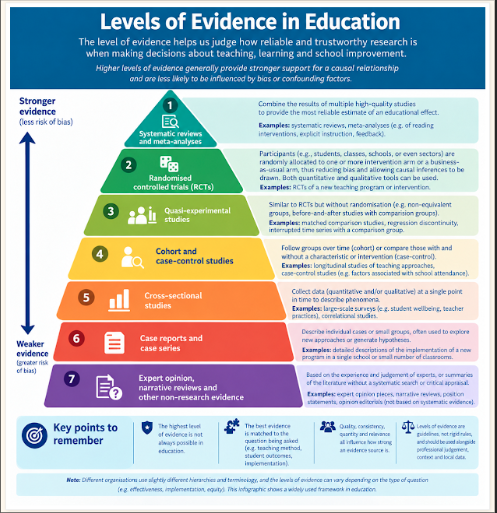
Levels of evidence in education. Infographic provided by Professor Pamela Snow.
Three things to remember when you use this ladder:
- The best evidence is the kind that fits the question. A trial of a reading program answers a different question from a survey of teacher well-being.
- Quality, consistency and relevance all count, not just the type of study.
- The levels are guidelines, not rigid rules. Use them alongside professional judgement, context and your own data.
If a program has no strong studies behind it, that isn’t proof it fails. It does mean your own data matters more. For literacy interventions used as Tier 2 support in Australian schools, Kate De Bruin’s review for Catholic Education Melbourne (Monash University, 2019) summarises the research on each and how well each aligns with effective instruction.
Step 5: Decide. Keep, add or change.
Keep what works and what your data supports.
Add where a strand is thin. Make supplementing your default. A school with strong phonics but little vocabulary teaching can add explicit word teaching and content-rich read-alouds without touching the phonics.
Change where the evidence or your own data says a practice isn’t working. This is harder than adding. It needs a plan.
Change is hard. Plan for it.
Most teachers teach the way they were trained. But our careers show how much we can grow and change. If there is a more effective way to do something, why would we stick with an older way?
Good intentions are not a plan, though. Change needs planning, and everyone needs to be on the same page. That is where a change plan and training come in.
A simple change plan. AERO’s work with schools and early childhood services uses four stages, adapted from the Education Endowment Foundation’s model.
| Stage | What it means for a literacy change |
| Explore | Use your audit and data to choose a practice that fits an identified need. Decide whether to go ahead. |
| Prepare | Build a detailed plan. Take a baseline. Make sure the team has the knowledge it needs before anything changes in classrooms. |
| Deliver | Put the practice into action. Check it is happening as planned and refine it. |
| Sustain | Keep monitoring. Refresh knowledge. Share examples of what good looks like. |
The stages are not a straight line. Teams can slow down or go back. AERO’s early childhood work found that services often rushed into change, and that using the stages led several to slow down and build knowledge first.
AERO’s guidance for school leaders also says to keep improvement plans to a small number of clear, evidence-based goals. Too many initiatives at once lead to change fatigue.
Training that sticks. AERO’s 2026 paper on implementation in schools offers four lessons.
- One-off sessions rarely change practice across a school. Cycles that combine knowledge-building, planning, modelling and coaching work better.
- Build expertise inside the school. Many primary schools in the project used their own staff to model and coach.
- Give people time. Time release for observation and coaching helped, and limited resourcing was a main barrier.
- Make sure everyone shares one picture of what the practice looks like, including in each year level.
Step 6: Review it as a team, across all year levels
Make the audit part of your regular review cycle. Look at it as a whole team, not one year level at a time. These questions help.
- Do we have a scope and sequence for each strand? Sedita describes systematic teaching as a planned sequence, from basic to more complex. A written sequence lets every teacher see what came before and what comes next.
- Does it run across all year levels? Look for gaps, where something is never taught, and overlaps, where the same thing is retaught every year.
- How does it adapt for the students we support? The sequence stays the same. Pace, scaffolds and intensity change. Check that students who need more support can reach the same content.
- How do we know it’s working? Look at screening and progress data by year level.
- Who owns it? Name a person or team to lead the review.
Then revisit it at least once a year. Data from your Tier 2 and Tier 3 groups, covered in Post 5, will show you where Tier 1 is thin.
If a printable version of the table would help your team, get in touch.
Next time: once you know what Tier 1 looks like, how do you keep extra support targeted?
Sources
- Scarborough, H. (2001). Connecting early language and literacy to later reading (dis)abilities.
- De Bruin, K. (2019). Tier Two Literacy Interventions in Australian Schools: A Review of the Evidence, Version 2.0. Monash University, for Catholic Education Melbourne.
- Australian Education Research Organisation (2026). Insights into implementation in schools in 2026. edresearch.edu.au
- Chng, A. and De Gioia, K. (2026). Implementing evidence-based practices in early childhood education and care, 2026. Australian Education Research Organisation.
- Lind, R., Davis, C. and Heenan, B. (2026). Leveraging evidence for system support. Australian Education Research Organisation.
- Snow, P. (2022). Leaving the Balanced Literacy habit behind: A theory of change. The Snow Report.
- Sedita, J. (2025). Principles of Effective Literacy Instruction. Keys to Literacy blog.
- Levels of evidence in education infographic, provided by Pamela Snow
Check out our series
The Language House: Why Reading Starts Long Before Prep
The Matthew Effect in Reading: Why Early Reading Matters So Much
What to Teach in Literacy: The Key Elements and How to Teach Them
What is your school already doing well? A literacy audit
Multi-tiered Support: Keeping Literacy Support Targeted
Implementing literacy change in schools: deciding what is in and what is out